Post
When AI Can Do the Physical Work
Matthew Rubin on why robotics and artificial intelligence belong together, what their progress could mean for everyday work, and what still needs to improve.
By Matthew Rubin · 
An AI system can help describe how to assemble a piece of equipment. Someone still has to pick up the parts, line them up, and notice when something does not fit.
That gap is why I am interested in the future of robotics and artificial intelligence together. So much of the work we depend on involves moving, inspecting, building, cleaning, or repairing something. Better software becomes much more consequential when it can help a machine perform that work.
For business owners and the people doing those jobs, the question is practical: when will these systems become dependable enough to help outside a demonstration?
How the two fit together
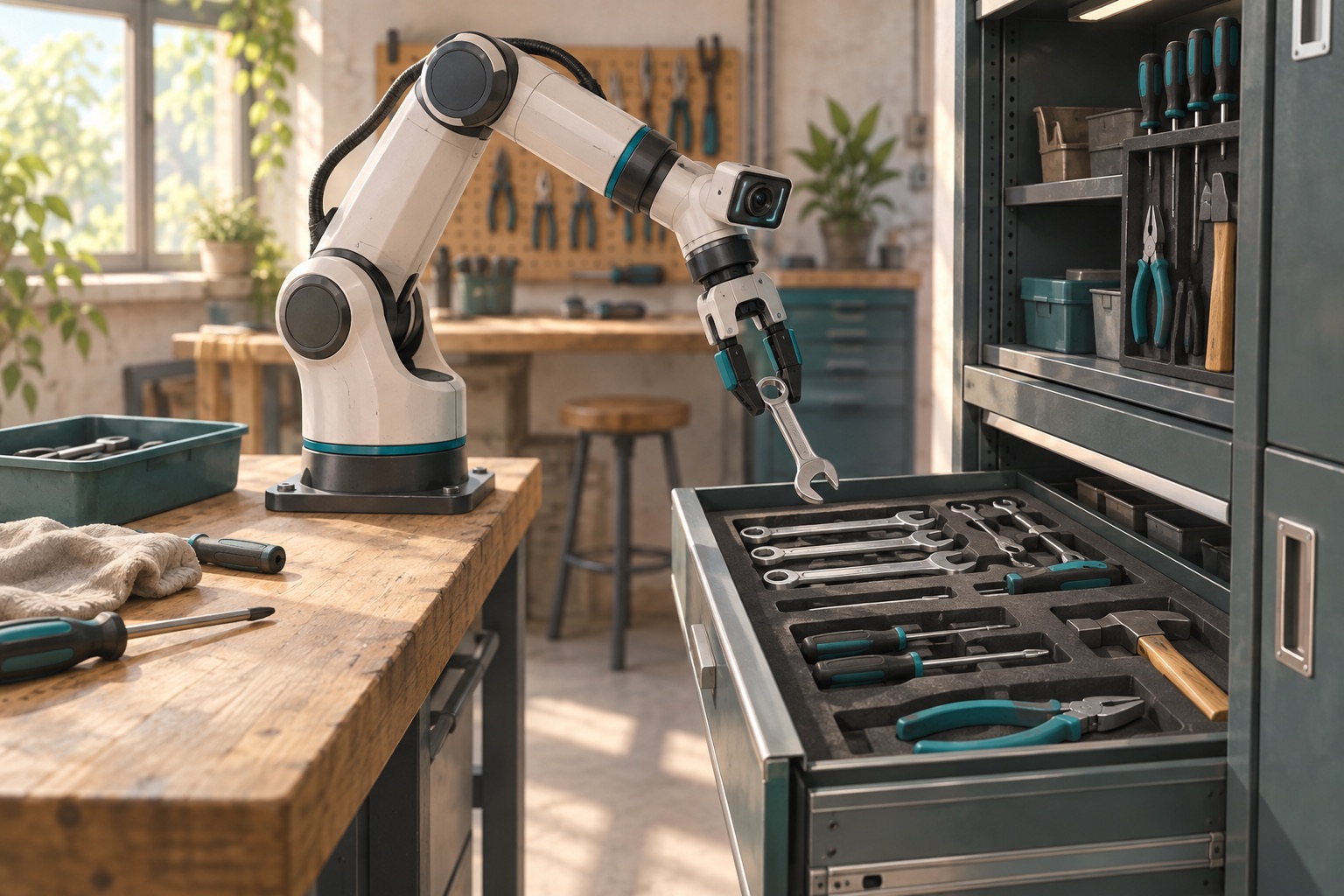
Recognize, grip, place, check: a simple task connects intelligence with physical action. AI-generated concept illustration, not an actual deployment.
A robot provides the physical equipment: motors, joints, wheels, grippers, and sensors. Its controls govern how that equipment moves. AI can help interpret what the sensors detect, understand an instruction, and choose an action when the situation varies. Many useful robots already operate with conventional programming; adding AI makes sense where greater adaptability solves a real problem.
Consider an illustrative task: sorting returned tools into a storage cabinet. The system needs to recognize each tool, locate a safe place to grip it, move it without striking anything, and check that it reached the right shelf. If a drawer is closed or a tool is damaged, the next step changes.
The connection between AI and robotics is this repeated cycle of observing, acting, and checking the result. Language can help specify the goal, but physical feedback tells the machine whether its action worked.
The progress is real—and uneven
In July 2026, Google DeepMind introduced Gemini Robotics 2, reporting advances in whole-body movement, handling objects, and coordination between robots. Its approach includes models for interpreting instructions and planning tasks, alongside models that translate visual and language inputs into movement. The same report acknowledges continuing difficulties with finger dexterity and movement speed. These are developer-reported research results, not a promise that a robot will perform any job reliably. Read Google DeepMind’s announcement.
NASA offers a different example. In January 2026, it reported that Perseverance had completed two Mars drives in December 2025 using waypoints generated with AI. Engineers checked the commands using a virtual replica of the rover before sending them to Mars. The AI-assisted route planning happened on Earth; this was not a language model independently running the entire mission aboard the rover. Read NASA’s account.
Both examples make me optimistic. They also show why it matters to ask exactly which part of a job the AI performs and how the result is checked.
Where I expect the next useful work
My expectation is that adoption will grow task by task. A business may find value in a machine that transports materials along a known route or inspects a consistent set of parts well before it can justify a robot that handles an entire department.
As perception and manipulation improve, I can imagine more flexible machines sorting unfamiliar items, helping maintain equipment, and handling repetitive physical work in spaces shared with people. Farther out, robots could help prepare infrastructure in places where sending people is difficult. My recent article about a possible Mars work crew explores that possibility.
These are directions I would watch, not a timetable. A machine that works in one warehouse may struggle with another building’s lighting, shelving, packaging, or traffic. The cost of adapting it matters as much as the capability shown in a video.
Nor does every useful robot need to look human. A wheeled carrier or a fixed arm may be easier to maintain and better suited to a particular task. I would choose the shape around the work.
The future still needs people who understand machines
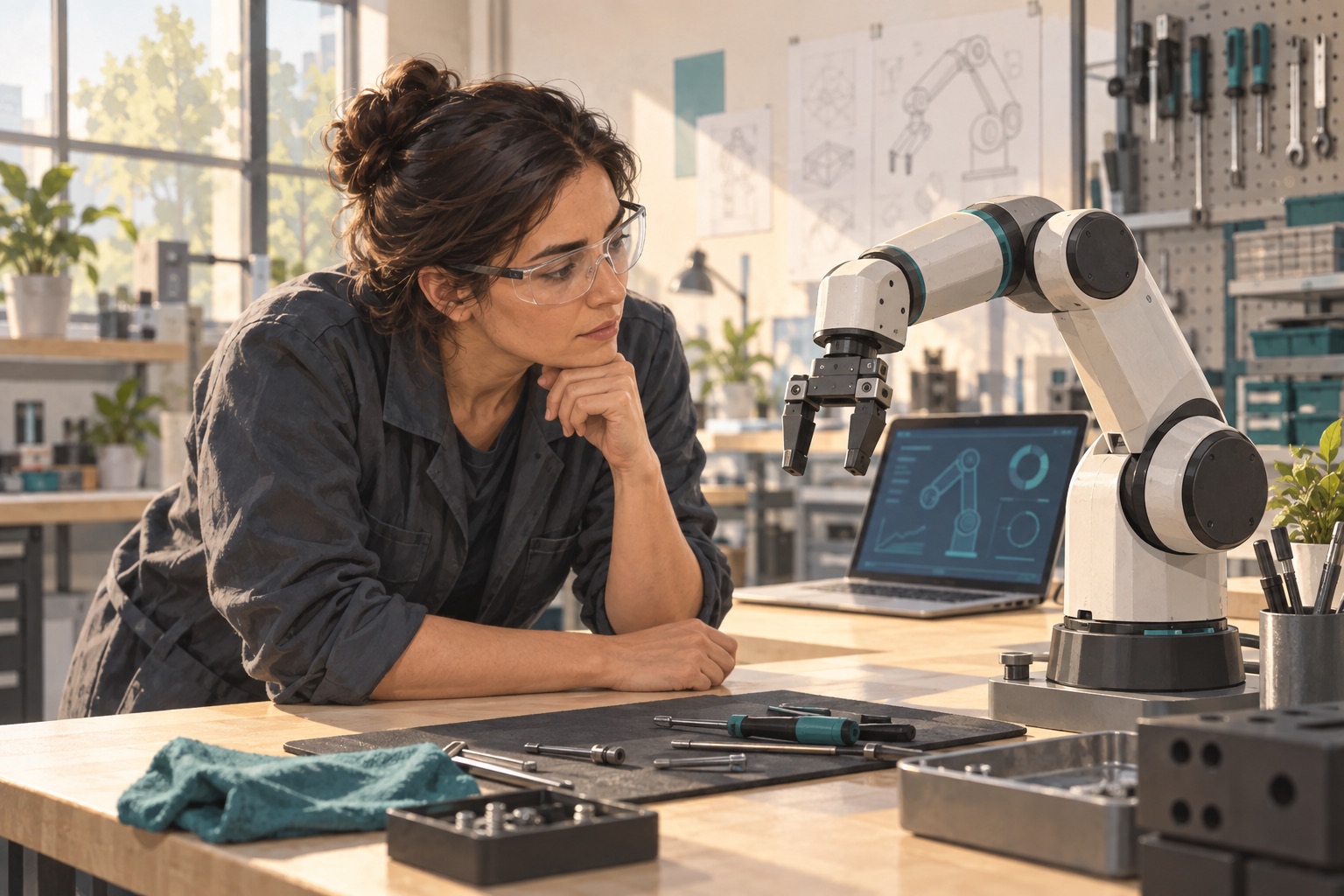
Human judgment, maintenance, and troubleshooting remain part of the work. AI-generated concept illustration; the person and setting are fictional.
A more capable robot will still need maintenance, testing, and someone who understands when its behavior has changed. Workers who know the process can spot exceptions that a demonstration never included. Their experience belongs in the design and evaluation from the beginning.
Education has a role here too. Mechanical understanding, electronics, software, and troubleshooting become more valuable when they meet in one system. I want students to learn how to test a machine’s answer against what actually happened: Did the object move? Was it damaged? Could the machine repeat the task?
Some tasks may disappear or change substantially as automation improves. New technical responsibilities will not automatically provide an easy transition for every affected worker. Employers will need to make deliberate choices about training, job design, and how the benefits are shared.
What would convince me to put a robot to work?
For a first project, I would define one job and measure completed work, errors, human interventions, downtime, and the total cost of keeping the system running. I would also want to see what happens when it loses its connection, encounters an unfamiliar object, or needs help.
At Standing Innovation, that is the perspective I bring to this future. A practical starting point is understanding a process well enough to identify where a machine could help and where a person needs to remain responsible. This is a direction to evaluate, not a claim that we have deployed these robotic systems for customers.
I am excited by the possibility of machines taking on exhausting repetition and helping people accomplish work they could not otherwise do. The progress I will pay attention to is a robot that finishes a useful task, handles an interruption, and can be maintained by the team relying on it. That is when advances in AI begin to change an ordinary workday.
Sources reviewed September 17, 2026. Future applications and adoption expectations are Matthew Rubin’s analysis; linked examples describe reported work by their respective organizations.